Grounding Sheet vs Earthing Sleep Mat: What’s the Difference?
BLACK FRIDAY SALE NOW ON | 20% Off No Code Required | +FREE Shipping On All Orders Over £70
Grounding Sheet vs Sleep Mat: Which Is Best? | BeGrounded
If you’re looking into sleeping grounded, you’ll quickly find two main options: the traditional grounding sheet, woven with silver thread, and the newer earthing sleep mat, which uses a conductive carbon layer. They aim to do the same job, but they’re built very differently, and those differences affect how long they last, how they feel and how you care for them. Here’s an honest comparison of a grounding sheet vs a mat, so you can decide which suits you.
New to grounding? Start with our complete guide to grounding sheets.
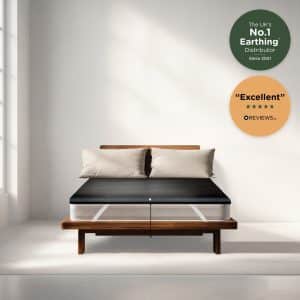
A grounding sheet is a cotton bed sheet woven with silver thread that you sleep on directly. An earthing sleep mat uses a durable carbon layer and sits under your normal bedsheet. Both connect you to the earth. Silver sheets feel more like ordinary bedding, while carbon mats keep their conductivity for much longer.

The silver grounding sheet, often sold as an earthing sheet, earthing half sheet or grounding fitted sheet, was the first mainstream way to sleep grounded at home. It’s usually made from cotton with a grid of fine silver-coated thread woven through it. A cord clips onto a stud on the sheet and plugs into the earth port of a UK socket.
There’s a lot to like about it:
The drawback is durability. Silver is an excellent conductor, but the thin coating on each thread wears away over time. That’s why many long-term users find their sheet gradually stops working.
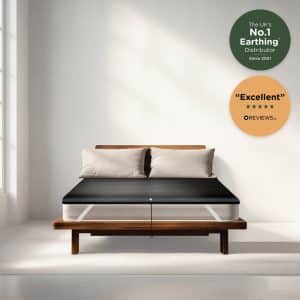
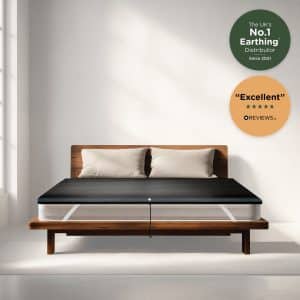
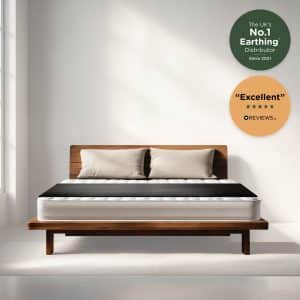
The earthing sleep mat is the current design from Earthing.com, the company that grew out of Clint Ober’s original grounding research. Instead of silver thread, it uses a conductive carbon layer across the top surface. It connects to the earth in exactly the same way, with a cord to the earth port of your socket or to a grounding rod outside.
The idea of sleeping on a conductive pad isn’t new. One of the first published studies on grounding during sleep had participants sleep on a conductive mattress pad in their own beds for eight weeks (Ghaly & Teplitz, 2004). The modern sleep mat is a refined version of that same idea.
The main differences you’ll notice:
| Silver grounding sheet | Carbon earthing sleep mat | |
| Conductive material | Silver-coated thread woven into cotton | Carbon layer across the surface |
| How it feels | Like an ordinary cotton sheet | Smooth; used under your own sheet |
| Skin contact | Needs direct bare-skin contact | Works through a thin cotton or linen sheet |
| Conductivity over time | Drops with washing and wear | Stays conductive much longer |
| Washing | Gentle cycle, special detergent, no softener or bleach | Wipe clean; occasional gentle wash |
| Coverage | Half sheets and fully fitted sizes | Mat sizes for one side or across the bed |
| Value over time | Lower upfront cost, but may need replacing | Higher upfront cost, longer working life |
This is the question we’re asked most by people switching from a sheet to a mat. There are three main causes.
Every wash removes a little of the silver coating. Ordinary detergents, especially those with bleach, optical brighteners or fabric softener, speed this up. After many washes, the conductive grid can become patchy.
Skin oils, moisturisers and body lotions coat the fibres over time. That residue sits between your skin and the silver and can weaken the connection.
Silver thread is fine and can snap where the sheet folds, stretches over mattress corners or meets the connection stud. A sheet can look perfectly fine while part of it no longer conducts.
The tricky part is that you can’t see or feel when a sheet stops working. The only way to know is to test it, which we explain in How to test if your grounding sheet is working. For care tips, see How to wash a grounding sheet.
No. With a silver sheet you need bare skin on the sheet itself, which is why the advice is usually not to put anything over it. A carbon sleep mat works differently in practice. Through the night your skin naturally releases moisture, and that moisture creates a conductive bridge through a thin natural-fibre sheet to the carbon layer below.
A few tips to get the best connection:
For most people sleeping grounded every night, we recommend the sleep mat. Not because the silver sheet doesn’t work, but because a grounding product only helps while it’s still conducting, and durability is where the carbon mat stands out.
If you already have a silver sheet, switching is simple:
Most UK grounding cords use the same type of plug, but always use the cord supplied with your mat.
It does the same job, connecting you to the earth while you sleep, but uses carbon instead of silver and sits under your bedsheet. Many people think of it as the modern grounding sheet.
When new, both conduct well enough to ground you. The bigger difference is over time: silver coating wears with washing, while a carbon layer keeps its conductivity much longer.
Yes, as long as it’s a thin, natural-fibre sheet such as cotton or linen. Avoid waterproof protectors or synthetic fabrics between you and the mat.
Yes, if it’s large enough to reach both of you. Many couples choose a mat each so each person has good contact on their own side.
The silver grounding sheet was a brilliant first step, and it introduced thousands of people in the UK to sleeping grounded. The earthing sleep mat is the next step: the same connection to the earth, from the company that started it all, built to keep working night after night. Read more about how both work in our guide to earthing sheets.
Explore Grounding Sheets & Sleep Mats – every sleep product comes with our 90-day sleep guarantee.
This article is for general information and isn’t medical advice. If you have a health condition or take regular medication, speak to your GP before starting grounding.