Grounding Sheets & Earthing Sheets: UK Guide | BeGrounded
BLACK FRIDAY SALE NOW ON | 20% Off No Code Required | +FREE Shipping On All Orders Over £70
Grounding Sheets & Earthing Sheets: The Complete UK Guide
By Mike Williams, Co-founder of BeGrounded, the first UK supplier of the Earthing® brand (since 2021). Last updated: 06 November 2026.
If you’ve been reading about grounding, you’ve almost certainly come across grounding sheets, also called earthing sheets. They’ve been around in the UK for well over a decade, and they’re still one of the most searched-for ways to ground indoors. But the sheets themselves have changed a lot since the first versions. In this guide we explain what a grounding sheet is, how it works, what the research says, how to use one safely, and why the original manufacturer now makes sleep mats instead.
A grounding sheet (or earthing sheet) is a bed sheet with conductive material woven into it, usually silver thread. A cord connects it to the earth, typically through the earth port of a correctly wired UK socket. Lying on it with bare skin connects your body to the Earth’s natural electrical charge while you sleep.
The idea is simple. Walking barefoot on grass, sand or soil puts your skin in direct contact with the ground. Most of us spend our lives indoors, in insulated shoes, sleeping several floors above the earth. A grounding sheet is a way of recreating that barefoot contact for the seven or eight hours you spend in bed.
You’ll see several names for the same idea: grounding sheet, earthing sheet, grounding bed sheet, earthing half sheet, grounding fitted sheet and, more recently, grounding sleep mat. They all aim to do the same thing, but how well they do it and how long they last vary a lot.
The modern story of grounding begins with Clint Ober, a former cable television executive. In the late 1990s he started asking whether the insulating effect of modern life (rubber-soled shoes, raised beds, indoor living) might matter for our health. His early experiments involved people sleeping on simple conductive pads connected to an earth rod outside.
Those experiments grew into the Earthing® company and the book Earthing (Ober, Sinatra and Zucker), which introduced the idea to a wide audience. One of the first published studies on grounding during sleep used a conductive mattress pad (see the research section below).
The first commercial products most people bought were cotton sheets woven with fine silver thread. Silver conducts electricity very well and the sheets felt like ordinary bedding, so for many years “earthing sheet” became the standard name for sleeping grounded. That’s why the term is still so widely used in the UK today.
A grounding sheet works by giving your body a conductive path to the earth. There are three parts:
The Earth’s surface carries a mild negative charge. The theory behind grounding is that conductive contact lets your body settle at the same electrical potential as the Earth, and gives it access to the Earth’s free electrons. Researchers have suggested these electrons may act as natural antioxidants. That idea is still being studied, so treat it as a hypothesis, not a settled fact.
Research into grounding is still a young field, but it has been growing for about twenty years. A few studies come up again and again:
As a business that sells grounding products, we think it’s important to be straight about this. Most grounding studies are small, many have no placebo group, and several were carried out by researchers with links to the grounding industry. The findings are encouraging and worth taking seriously, but they aren’t conclusive. If you have a health condition, grounding is something to explore alongside your doctor’s advice, not instead of it. We’ll look at each study in more detail later this month.
This is the part most guides leave out. The original cotton and silver-thread sheets worked, but they had a well-known weakness: they didn’t last.
Many long-term users found they needed to replace their grounding sheet regularly, often without realising it had stopped working.
This is the part most guides leave out. The original cotton and silver-thread sheets worked, but they had a well-known weakness: they didn’t last.
Many long-term users found they needed to replace their grounding sheet regularly, often without realising it had stopped working.
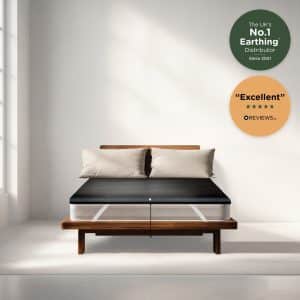
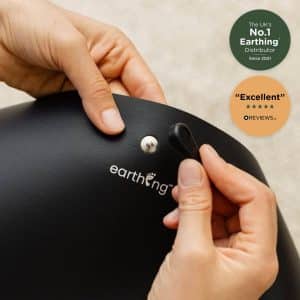
That’s why Earthing.com, the company that grew out of Clint Ober’s work, moved away from silver sheets to the Earthing® Sleep Mat. Instead of silver thread, it uses a conductive carbon layer bonded to the mat. Carbon doesn’t wash out like silver, so the mat stays conductive for much longer.
The carbon surface has a slightly smooth, slippery feel. Most people place their usual cotton or linen bedsheet over the top. The natural moisture your skin releases overnight keeps the connection through a thin natural-fibre sheet, so you stay grounded while your bed feels the way it always has.
| Silver thread grounding sheet | Carbon Earthing® Sleep Mat | |
|---|---|---|
| Feel | Like ordinary cotton | Smooth, used under your own sheet |
| Lifespan | Conductivity drops with washing | Carbon layer stays conductive much longer |
| Washing | Gentle, special detergent, no softener | Wipe clean and allow to dry. No need for machine washing. |
| Direct skin contact needed? | Yes | Works through a thin cotton or linen sheet |
| Where you’ll find it | Many UK and marketplace sellers | The current Earthing® design |
A properly made grounding sheet connects only to the earth of your socket. It doesn’t touch the live or neutral wiring, so there’s no mains current flowing to the sheet. Even so, here’s what to check:
Whether you choose a traditional sheet or a modern sleep mat, ask these five questions before you buy:
At BeGrounded, all our sleep products come with a 90-day sleep guarantee, so you can try sleeping grounded through a full season before deciding. Explore Grounding Sheets & Sleep Mats
Some people notice a difference within a few nights; for others it takes a few weeks. Give it time and keep a simple sleep diary so you can judge for yourself.
Nothing. They’re two names for the same thing. “Earthing” is more common in the UK and “grounding” in the US, but both describe a conductive sheet that connects you to the earth while you sleep.
With a silver-thread sheet, yes. With a carbon Earthing® Sleep Mat, a thin natural-fibre sheet over the top still lets you ground, because your skin’s natural moisture keeps the connection.
Silver sheets gradually lose conductivity with washing and wear, and many users replace them regularly. Carbon sleep mats are designed to stay conductive for much longer.
Yes. The connection runs through your home’s earthing system via the socket, so it works on any floor as long as the socket is properly earthed.
Yes you can as long as it is underneath your grounding sheet or sleep mat.
Grounding sheets helped thousands of UK sleepers start grounding indoors, and the idea behind them is as relevant as ever. What’s changed is the technology. If you want the simplest, longest-lasting way to sleep grounded, the modern carbon sleep mat is the evolution of the earthing sheet, and it comes from the company that started it all.
Shop Grounding Sheets & Earthing Sleep Mats – 90-day sleep guarantee
This article is for general information and isn’t medical advice. If you have a health condition or take regular medication, speak to your GP before starting grounding.