Do Grounding Mats Actually Work?
FREE Shipping On All Orders Over £70
Grounding mats have gone from niche wellness product to mainstream interest in the past decade. With that growth has come a fair share of scepticism, and fairly so. If you’re considering buying one, or you already own one and want to know whether it’s doing anything, you deserve a straight answer grounded (no pun intended) in the actual science.
This post covers the mechanism, the peer-reviewed research, what results you can realistically expect, and something most grounding blogs won’t tell you: why not all grounding mats and sheets are created equal, and why the material your product is made from determines whether it works at all.
Before evaluating whether they work, it helps to understand what they’re actually claiming to do.
The Earth carries a natural, stable negative electrical charge on its surface. When you make direct contact with the ground, bare feet on grass, skin on soil, standing in the sea, free electrons from the Earth flow into your body. These electrons act as natural antioxidants, neutralising positively charged free radicals. These are the unstable molecules that drive inflammation, oxidative stress, and cellular damage.
For most of human history, this exchange happened constantly. We slept on the ground, worked barefoot, waded through streams. Modern life has almost entirely severed that connection. Rubber-soled shoes, elevated beds, synthetic flooring, and buildings with no conductive path to the Earth mean most people go days, weeks, or even months without a single meaningful contact with the ground.
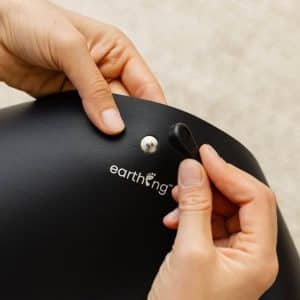
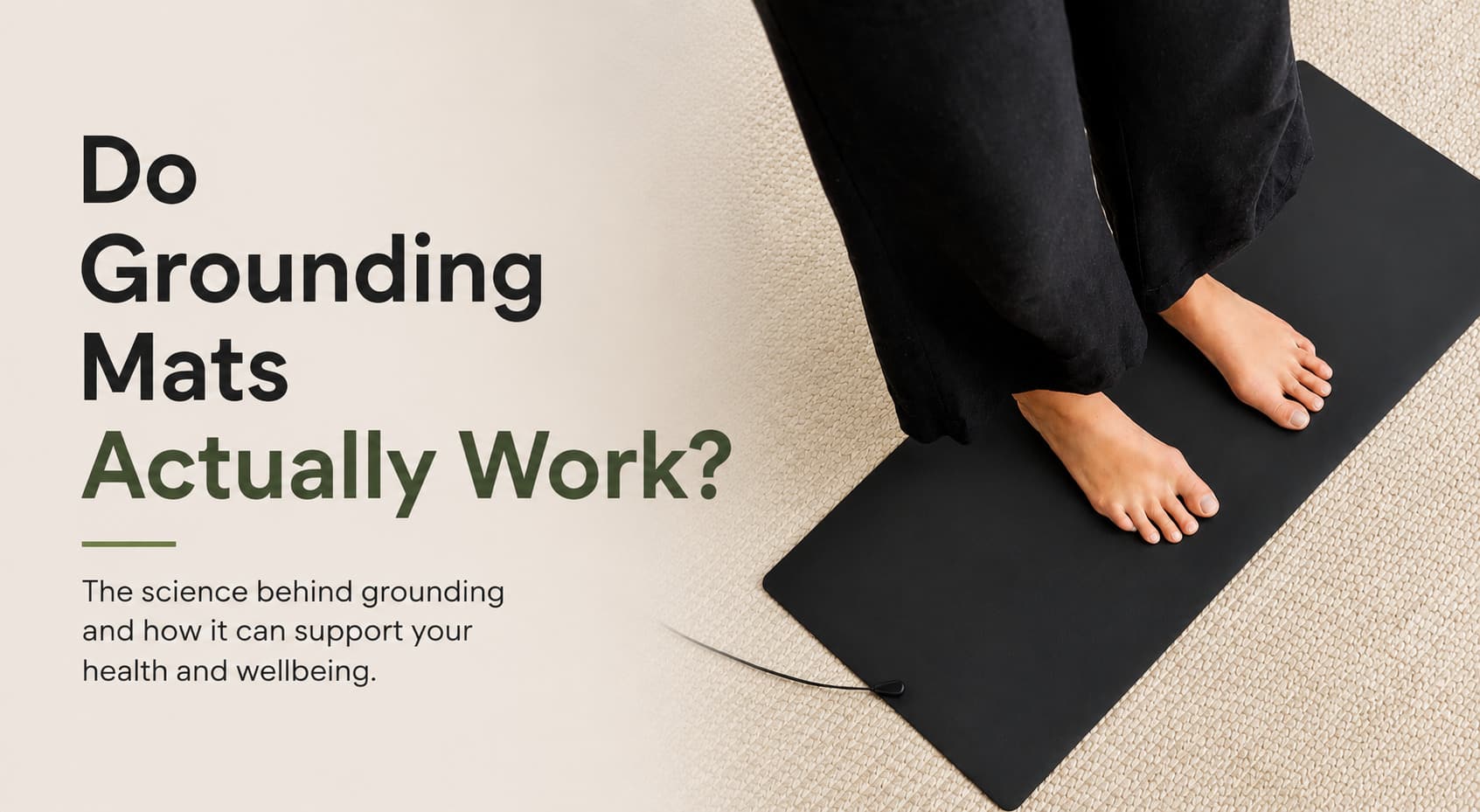
A grounding mat replicates that contact indoors. It uses a conductive surface connected via a cord to the earth pin of a standard wall socket, the round bottom pin in a UK socket, which connects through your home’s wiring to a grounding rod buried in the soil outside. When you sit or sleep on the mat, electrons flow from the Earth, through that circuit, and into your body. You can read more about the basics of how earthing works here.
The mechanism is grounded in straightforward physics and well-understood electrical principles. The more important question is: does that electron transfer produce measurable changes in the body?
Grounding research is still a relatively young field, but the published, peer-reviewed literature is more substantial than critics often acknowledge. Here is what the key studies found:
Sleep and Cortisol Regulation
The most consistently replicated finding across grounding research is improved sleep quality, linked to normalisation of the stress hormone cortisol.
Ghaly and Teplitz (2004), published in the Journal of Alternative and Complementary Medicine, measured overnight cortisol levels in 12 subjects sleeping on grounding mattress pads. The results showed clear normalisation of cortisol secretion, with cortisol following a more natural diurnal rhythm, peaking in the morning and tapering off through the day. Participants also reported subjective improvements in sleep quality, reduced pain, and lower stress.
A more recent randomised controlled trial (2025, published in ScienceDirect) confirmed these findings, showing that earthing mats produced measurable reductions in insomnia severity, stress, and daytime sleepiness compared to a sham-grounded control group.
A pilot study published in PMC also found that grounding improved sleep quality in patients with mild Alzheimer’s disease, a population with notoriously disrupted circadian rhythms, suggesting the cortisol-regulating mechanism is real and robust. You can explore more of the studies on our earthing research page.
Inflammation
This is the area with perhaps the strongest mechanistic case. Oschman et al. (2015), published in the Journal of Inflammation Research, reviewed the accumulated body of grounding research and proposed that free electron transfer from the Earth acts as a natural antioxidant system. Free radicals, produced during normal metabolic activity, injury, or immune response, are positively charged and require an electron to stabilise. Without sufficient free electrons in the body, they steal electrons from healthy tissue, triggering chronic inflammatory cascades.
Grounding directly addresses this deficit. The review also referenced infrared imaging data from Dr. James Oschman showing visible reductions in inflammation around injury sites following grounding. We look more closely at this research in our post on whether grounding reduces inflammation.
Blood Viscosity and Cardiovascular Health
Chevalier et al. (2013), published in the Journal of Alternative and Complementary Medicine, demonstrated that two hours of grounding significantly increased the surface charge (zeta potential) of red blood cells, reducing their tendency to clump together. Sticky, clumped blood cells are a known risk factor for cardiovascular disease, as they impair circulation and reduce oxygen delivery to tissues.
This is one of the most striking findings in grounding research: measurable cardiovascular benefit from two hours of contact with a grounded surface.
Mood and Stress
Chevalier (2015), published in Psychological Reports, conducted a double-blind study in which 40 participants were either grounded or sham-grounded for one hour. Those who were genuinely grounded showed statistically significant improvements in pleasant and positive mood states compared to controls, improvements beyond what relaxation alone could account for.
Muscle Recovery
A pilot study by Brown, Chevalier, and Hill examined grounding’s effect on delayed-onset muscle soreness (DOMS), the inflammation-driven pain that follows intense exercise. Grounded participants showed measurable changes in immune system markers and faster recovery, supporting the idea that grounding can modulate the body’s inflammatory response in real time.
The Honest Caveat
It is worth being transparent: most grounding studies involve small sample sizes, and the field still lacks the large-scale, double-blind randomised controlled trials that would satisfy mainstream medicine’s evidentiary standard. Some sceptics, including a Yale professor of neurology writing for Science-Based Medicine, argue that the underlying electrical homeostasis claim hasn’t been definitively proven.
That’s a fair critique of the field’s maturity. But “more research needed” is not the same as “no evidence.” The existing body of peer-reviewed work, across sleep, inflammation, blood viscosity, mood, and recovery, consistently points in the same direction. For a complementary wellness practice with no side effects and no cost beyond the product itself, the evidence-to-risk ratio is strongly favourable.
This is where it gets important, because in many cases the product genuinely isn’t working. Not because grounding is ineffective, but because the mat has stopped being conductive.
The Silver Thread Problem
Most grounding sheets and mats sold today, particularly those sold cheaply online, use silver-threaded fabric. Silver is an excellent conductor, which is why it was adopted early in the earthing product market. But it has a critical flaw which is oxidation.
When silver comes into contact with oxygen, sweat, body oils, and detergent, a layer of silver oxide forms on the surface. Silver oxide is an insulator. As this layer accumulates over months of use, conductivity deteriorates and eventually fails entirely. We’ve written in detail about this problem and why you should stop using silver-threaded sheets here.
The particularly insidious aspect of silver oxidation is that it is invisible. Your sheet looks exactly the same. It feels the same. You’re going through the same motions of plugging it in and sleeping on it. But if you were to test conductivity with a multimeter, you might find that no electrons are flowing at all.
Research suggests silver-threaded sheets can begin losing meaningful conductivity within six to twelve months of regular use. Budget products with lower silver content may fail even faster. This is the most likely explanation when someone reports that their grounding mat “stopped working,” or more commonly, when they report that it never seemed to do anything, having unknowingly purchased a product that was already failing.
BeGrounded’s Earthing® Elite™ range uses a carbon-infused conductive layer rather than silver threads. Carbon does not oxidise. It does not degrade with washing, sweat, or air exposure. Its conductivity remains consistent over years of use, not months.
This matters enormously when you consider what the research is actually measuring. The studies showing cortisol normalisation, blood viscosity improvements, and inflammation reduction were conducted using properly functioning, consistently conductive grounding products. A mat that has lost conductivity isn’t replicating those conditions. It’s simply a mat.
The carbon-infused design also provides uniform conductivity across the entire surface, rather than the grid pattern used in silver-threaded products where a single break in the circuit near the connection point can render the entire sheet non-functional.
BeGrounded is also the UK’s certified official Earthing® distributor, which means the products are the same ones used in and referenced by the clinical research, not replicas or generic alternatives built to a lower standard.
To ensure your setup is working correctly at any time, you can test your grounding connection using a multimeter, something we always recommend for anyone starting out or troubleshooting.
Based on the research and consistent customer experience, here is what grounding mats do well:
Sleep – The most reported and most research-supported benefit. Most people who use a grounding mat or earthing sheet consistently during sleep report falling asleep faster, sleeping more deeply, and waking feeling more rested within the first two to four weeks.
Inflammation and pain – Particularly notable for people with chronic inflammatory conditions such as joint pain, arthritis, and recurring muscle soreness. Results here tend to be gradual rather than immediate, with most people noticing meaningful change after four to eight weeks of consistent nightly grounding.
Stress and cortisol – Many users report a reduction in general tension, improved mood, and a greater sense of calm, consistent with the cortisol-normalising effect observed in the research.
Energy – As sleep quality improves and inflammatory load reduces, many people report improved daytime energy levels, not stimulant energy, but a steadier, more sustainable baseline. Read about how grounding supports mitochondrial energy here.
What grounding mats are not – a rapid fix, a replacement for medical treatment, or universally effective for every person in every condition. They are a tool for restoring a connection the body evolved to have, and the benefits accumulate with consistency.
Yes, to a degree. Thin natural fabrics like cotton allow some electron flow. However, direct skin contact, bare feet on a mat or sleeping on a grounding sheet, is significantly more effective than contact through clothing.
Some people notice changes within the first few nights, particularly in sleep quality. For inflammation and pain, most people see meaningful results after four to eight weeks of consistent nightly use.
Yes. The earth pin of a standard socket carries no current under normal conditions. It is a safety path to the Earth, not part of the live electrical circuit. Quality grounding cords also include an inline resistor as an additional safety measure.
The electron transfer mechanism is the same. Both connect your body to the Earth’s electrical charge. Outdoor grounding has the additional benefits of fresh air, natural light, and movement. But a grounding mat used consistently during sleep will deliver more total contact hours than most people could practically achieve outdoors, making it more effective in practical terms for most people’s daily lives.
If you have a silver-threaded product, it very likely has. Test conductivity with a multimeter. If conductivity has degraded, the product needs replacing, ideally with a carbon-based alternative that will maintain performance long term.